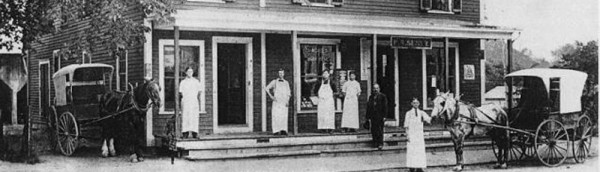
Leeds, Massachusetts, is a geat neighborhood within the city of Northampton and the most distant from the center. Like Florence and Bay State, the other districts in the community with distinctive identities, its history is linked to the Mill River.
The exact boundaries of Leeds have never been agreed on. Whether the Veterans Hospital is in Leeds or Florence has never been resolved but Leeds definitely begins where Florence Street branches off from Route 9. It is also generally agreed that Maine’s Hill residents on Haydenville Road can also claim Leeds citizenship.
Except for the rare farmer or the hostelries on the turnpike to Albany, Leeds (and Florence as well), saw no significant settlement for a century and a half after the settlement of Northampton in 1654. With the arrival of the industrial revolution the river suddenly assumed great importance as the source of abundant waterpower.
The Mill River had always supplied power for the few mills where farmers could have their grains ground or, at a later time, their trees cut into lumber at sawmills. In the 19th century, the river became the powering agent for the production of paper, cotton and wool cloth, silk products, buttons, baskets, brass products, shovels and hoes, brushes, picture frames, emery wheels…in total, an extraordinary variety of manufactured products of all kinds.
In 1874 it all changed when a dam built in Williamsburg by the factory owners to provide a constant and regulated flow of water suffered a catastrophic failure that devastated the Mill River valley. The economy of the area was destroyed but the cost in human terms was worse. In Leeds alone, 51 people died in the raging floodwaters. The toll from the flood reached over 140 with 37 of the victims from Haydenville and Williamsburg found in Leeds and Florence. In 1999, memorials recalling the disaster and listing the names of the victims were erected in Leeds, Haydenville and Williamsburg. The Leeds Memorial is set on the bank of the Mill River in the very heart of the area where so many lives were lost.
If you drive up Main Street in the center of Leeds in the year 2000, you will find five dams (in varying condition) and five bridges in less than a half mile. The dams (Top Dam, Middle Dam, Bottom Dams and Cook’s Dam) are a legacy of the time when the Main Street of Leeds was lined with factories. Today the only reminders of that era are the few brick factory buildings on Water Street and the Leeds Village Apartments, an industrial bee-hive of years past on Main Street. The river, once of substantial depths, is now barely a foot deep in most areas as silt has filled the areas behind each dam.
Where once there were four grocery stores in the village’s center, now there are none. Where a depot once stood as a stop for the four passenger trains passing through the village each day on the way to Williamsburg there is now only a deserted roadbed.
Today, a libation to slake one’s thirst at the Northampton Country Club is the only reminder that once there were a number of places in Leeds where the dust of a day’s work could be washed away. While some of those oases were properly sanctioned like the Leeds Inn or the Warner and Moody Taverns of old there were others less restricted by the niceties of legal licensing.
Today few residents are aware that the neighborhood below Cook’s Dam near the Country Club is “Irish Town” or that the school rests on “Schoolhouse Hill”. Few identify their elevated neighborhood dominated by the Dimock Estate as “Yankee Hill.” Water Street has lost its identity as the “French quarter” of Leeds and who knows where “Howard’s Pasture” is, or “Crow Hill”, “Robert’s Meadow”, “The San”, or “Seven Houses”?
Who knows that the first Charlie Chan of the movies, Warner Oland, found his bride, Edith Shearns, right here in Leeds? He returned often to his home opposite the Chart Pak factory where he had his own private tennis court. He was also a frequent golfer at the Warner Meadow Golf Club (now Look Park) and the Northampton Country Club.
Leeds also produced a Governor of Massachusetts. Thomas Talbot was a member of the Executive Council from 1864 to 1869, Lieutenant Governor from 1872 to 1873, Acting Governor, 1874, and Governor of Massachusetts in 1879-1880. He lived on Water Street from 1831-1835.
There was a time when Leeds was not generally regarded as the most desirable place to be from. But that was long ago. In 2000 Leeds is regarded as one of Northampton’s most desirable residential locations. The proof may be found in the Transfers of Property reported each week in the Registry of Deeds. The cost of land and the price of homes would be inconceivable to those who lived in Leeds in earlier eras. Homes in the hundreds of thousands of dollars are common in this little town where, in 1932, houses belonging to the defunct silk company were being sold throughout the community for hundreds, not hundreds of thousands of dollars.
Those who were born and raised in Leeds always knew there was no better place to live. It just took the rest of the world a little longer to make that discovery.
For those interested in more information about Leeds, we heartily recommend the work by Robert P. Emrick “Leeds, A Village Within the City of Northampton, Massachusetts.”
December, 2000

LCA Treasurer’s Report: February, 2012
A Short History of Leeds
Leeds, Massachusetts, is a geat neighborhood within the city of Northampton and the most distant from the center. Like Florence and Bay State, the other districts in the community with distinctive identities, its history is linked to the Mill River.
The exact boundaries of Leeds have never been agreed on. Whether the Veterans Hospital is in Leeds or Florence has never been resolved but Leeds definitely begins where Florence Street branches off from Route 9. It is also generally agreed that Maine’s Hill residents on Haydenville Road can also claim Leeds citizenship.
Except for the rare farmer or the hostelries on the turnpike to Albany, Leeds (and Florence as well), saw no significant settlement for a century and a half after the settlement of Northampton in 1654. With the arrival of the industrial revolution the river suddenly assumed great importance as the source of abundant waterpower.
The Mill River had always supplied power for the few mills where farmers could have their grains ground or, at a later time, their trees cut into lumber at sawmills. In the 19th century, the river became the powering agent for the production of paper, cotton and wool cloth, silk products, buttons, baskets, brass products, shovels and hoes, brushes, picture frames, emery wheels…in total, an extraordinary variety of manufactured products of all kinds.
In 1874 it all changed when a dam built in Williamsburg by the factory owners to provide a constant and regulated flow of water suffered a catastrophic failure that devastated the Mill River valley. The economy of the area was destroyed but the cost in human terms was worse. In Leeds alone, 51 people died in the raging floodwaters. The toll from the flood reached over 140 with 37 of the victims from Haydenville and Williamsburg found in Leeds and Florence. In 1999, memorials recalling the disaster and listing the names of the victims were erected in Leeds, Haydenville and Williamsburg. The Leeds Memorial is set on the bank of the Mill River in the very heart of the area where so many lives were lost.
If you drive up Main Street in the center of Leeds in the year 2000, you will find five dams (in varying condition) and five bridges in less than a half mile. The dams (Top Dam, Middle Dam, Bottom Dams and Cook’s Dam) are a legacy of the time when the Main Street of Leeds was lined with factories. Today the only reminders of that era are the few brick factory buildings on Water Street and the Leeds Village Apartments, an industrial bee-hive of years past on Main Street. The river, once of substantial depths, is now barely a foot deep in most areas as silt has filled the areas behind each dam.
Where once there were four grocery stores in the village’s center, now there are none. Where a depot once stood as a stop for the four passenger trains passing through the village each day on the way to Williamsburg there is now only a deserted roadbed.
Today, a libation to slake one’s thirst at the Northampton Country Club is the only reminder that once there were a number of places in Leeds where the dust of a day’s work could be washed away. While some of those oases were properly sanctioned like the Leeds Inn or the Warner and Moody Taverns of old there were others less restricted by the niceties of legal licensing.
Today few residents are aware that the neighborhood below Cook’s Dam near the Country Club is “Irish Town” or that the school rests on “Schoolhouse Hill”. Few identify their elevated neighborhood dominated by the Dimock Estate as “Yankee Hill.” Water Street has lost its identity as the “French quarter” of Leeds and who knows where “Howard’s Pasture” is, or “Crow Hill”, “Robert’s Meadow”, “The San”, or “Seven Houses”?
Who knows that the first Charlie Chan of the movies, Warner Oland, found his bride, Edith Shearns, right here in Leeds? He returned often to his home opposite the Chart Pak factory where he had his own private tennis court. He was also a frequent golfer at the Warner Meadow Golf Club (now Look Park) and the Northampton Country Club.
Leeds also produced a Governor of Massachusetts. Thomas Talbot was a member of the Executive Council from 1864 to 1869, Lieutenant Governor from 1872 to 1873, Acting Governor, 1874, and Governor of Massachusetts in 1879-1880. He lived on Water Street from 1831-1835.
There was a time when Leeds was not generally regarded as the most desirable place to be from. But that was long ago. In 2000 Leeds is regarded as one of Northampton’s most desirable residential locations. The proof may be found in the Transfers of Property reported each week in the Registry of Deeds. The cost of land and the price of homes would be inconceivable to those who lived in Leeds in earlier eras. Homes in the hundreds of thousands of dollars are common in this little town where, in 1932, houses belonging to the defunct silk company were being sold throughout the community for hundreds, not hundreds of thousands of dollars.
Those who were born and raised in Leeds always knew there was no better place to live. It just took the rest of the world a little longer to make that discovery.
For those interested in more information about Leeds, we heartily recommend the work by Robert P. Emrick “Leeds, A Village Within the City of Northampton, Massachusetts.”
December, 2000
Rambles Around Town
In Leeds, by the timeyou read this, it will have been around 75 days since our last big snow storm of the season. Push ahead 75 more days and we’ll be nearing April. With the lack of snow local walking conditions have been superb.
Since”Irene” ripped through town, about 75 days ago, our very own Mill River has become a sourse of some surprising changes. New islands, hillsof silt and enormous tree trunks and wooden beams are suddenly apperaring from the Haydenville/Ledds line to the Northampton Country Club/Fairway Village Condos. Follow either side of the river and you are sure to find many surprises of local interest. But get closer to the river’s edge and you’ll find lots of items from the daily lives of those who lived before us.
Pottery, crocks, glass bottles, river glass, leather soles, buttons, enamel ware, brass and copper tubing, yellow and red bricks,(with lettering), railroad ties, spikes, plates and latches, these chards of all sorts everywhere. The longer you look the more you’ll see. Take advantage of the freakishly warm weather of late and the ever-steady presence of our very own Leeds section of the Mill and wander up or down stream. You will not be disappointed.
The Mark and Patricia Bradford Memorial Fund
Soon-to-be 2012 graduates of Smith Vocational H.S. and Northampton H.S. are encouraged to apply for the Bradford Scholarship. This award goes to a Leeds resident who has a desire to continue their education at college or advanced vocational training. Application requirements and paperwork can be obtained through the school’s Guidance offices. Contact Richard Greene (584 5525) or Earl Meunier (584-8858) with questions about the Bradford Memorial Fund.
LCA Treasurer’s Report: January, 2012
LCA Minutes: January 10, 2012
In Attendance: Joel Emrick, George Kohout, Sue Carbin, George Mirriam, David Rondina (Notes), Stephy Cho, Alice Badecker, John Lutz
1) Review of last meeting’s minutes. Passed without corrections – note to eventually post minutes on web site
2) New Business – John Lutz of Haydenville Road advised the LCA of the following happenings in Leeds:
There is a proposed structure to be built by owner John Chakalos (Linda Manor) of 76k sq ft3 story 80 person senior living building on 8-10 acres. There has been limited and/or short notice of Notice to Abutters regarding the project. He and other neighbors are looking for “sensitivity to the locals” throughout this process. They want the LCA and its members to be aware of some of the issues including proximity to the main street and other houses, lighting, traffic, intersections, and its relation to Linda Manor in its operation and organization.
3) Update on Leeds Conservation Areas (handout)
4) LCA calendar of events update:
5) Heidi said “yes” to producing the Newsletter. Sue will still do the January 2012
6) Website – We now have outdated software that is no longer supported. LCA has authorized Joel to look for and purchase a new web design software in the $100 range
7) Joel asks about maintenance in the Veteran’s Memorial Park across from Leeds School.
8) Next Meeting : February 14th, 7:00 PM, Leeds Teacher’s Lounge
Meeting adjourned at 8:55
LCA Minutes: December 13, 2011
In Attendance: Jim Mias, Joel Emrick, George Kohout, Sue Carbin, Deb Jacobs, David Rondina (Notes), Earl Meunier, Stephy Cho, Alice Badecker
1) Thank you to Sue Carbin for 12 years of Presidency and unrivaled leadership
2) Treasurer’s report: –
3) New Board Members and renewal of policies
4) Rail Trail Signage
5) Newsletter
6) Hotel Bridge Update: CPA gave LCA $35k for an engineering study for the Hotel Bridge. As of this meeting, nothing has been done other than close the bridge due to “liability’s sake”. Waiting for update from N’ton DPW and to schedule community meeting w/ engineers (Stantec)
7) New Beaver Brook Conservation Area; City purchased 2 lots across from Electric Company on Rte 9
8) Website – George, David, and Joel will meet at the end of the meeting to discuss the website. Results will be discussed at next meeting. (update)
9) Events to be discussed and finalized in January’s meeting :
10) Next Meeting : January 10th, 7:00 PM, Leeds Teacher’s Lounge
Meeting adjourned at 8:20
LCA Elections for 2012
The Association held it’s biannual elections at the November meeting and we would like to thank your neighbors below for volunteering to guide the LCA over the next few years. Congratulations to all! These positions take effect on December 1, 2011
Leeds Photo of the Month – May 2012
Three Little Bears on Grove Avenue. Photo by Julie Akeret (EAW). Do you have a great photo that was taken in Leeds? Read more
Leeds Photo of the Month – March 2012
Hotel Bridge Reflection – Leeds 2012. Photo by Heidi Stevens. Do you have a great photo that was taken in Leeds? Read more